




A dimly lit laboratory bench: glass flasks and tubing on a stand, with amber reagent bottles in the foreground

ORVENNE-1 · XR-01 directed regeneration complex

Injury becomes temporary. So does age.

ORVENNE-1 finds damage by a signature only cut tissue carries, then rebuilds along the fibre lines the tissue was already using. Before the cycle closes it returns the telomere the rebuild spent. Three phases. Seventy-two hours. Nothing runs out of order.

×0.0 Closure velocity against matched controls, 0–24 h 2.83 vs 0.75 pts/h
+0.0% Median telomere reserve at 52 weeks, against the same person at intake n = 4,820
Dark-field micrograph of a fluid sample: pale blue crystalline bursts and rust-red discs scattered across black

Where this starts

The slope nobody
warns you about

Repair capacity does not fail. It leaks. The model below tracks four coupled curves from twenty to eighty — the four that between them decide how a body answers an injury, and how much of that answer it gets to keep.

A cloud of fine particles dispersing across a black field, dense at the right edge and thinning away to nothing at the left

Repair is a budget. It is spent daily, and after the third decade it is never topped up again.

FOUR COUPLED CURVES · INDEXED TO AGE 20

The same cut, at twenty-two and at sixty-five, is not the same event.

Ask anyone who has broken the same bone twice, decades apart. It knits either way. What changes is the interval, the amount of scar the body is willing to settle for, and how much of the surrounding tissue gets quietly written off along the way.

The interval is the visible part. Underneath it sit four curves that fall together, and the falling together is the difficulty. Lift one and the other three pull it back down. Give a sixty-year-old the energy supply of a twenty-year-old and the fibroblasts still arrive late, the collagen they lay down is still cross-linked in the wrong pattern, and the progenitor pool they draw from is still close to empty.

Single-target work in this area therefore buys a very good six weeks followed by a flat year. ORVENNE-1 starts from the opposite premise: the four move as one, so the four are corrected on one clock.

A rendered field of upright cylindrical rods of uneven height, packed close together and falling away towards the back
INDEX ARRAY · AGE 20 → 80
Modelled decline in repair capacity
index, age 20 = 100 · x: age 20 → 80
Regeneration rate Telomere reserve

This axis carries the two curves that share a scale. Fibroblast arrival runs in hours and cross-link density in bonds per unit volume; both are measured on every cohort and both are reported on scales of their own.

Tissue regeneration rate at 65 9
Telomere reserve at 65 46
Mitochondrial ATP output at 65 53

All three readings run against one indexed baseline at age twenty. These are population curves: the individual variation is in which decade the fall starts, not in whether it does.

Laboratory glassware in low light: a flask on a stand, a white evaporating dish and several amber reagent bottles

0.42 g · three release phases

What is actually
in the bottle

Macro photograph of a two-tone capsule filled with orange pellets, resting against a dark spherical tablet
ORVENNE-1 · inspection bench 0.42 G UNIT · THREE-PHASE FILL
Fill line — vials and ampoules at inspection

ORVENNE-1

XR-01 complex

ORVENNE-1 is a delivery problem solved three times over. Making the complex takes a week. Getting it to a wound, holding it there for seventy-two hours while the immune system reads it as ordinary traffic, and having it leave on schedule: that is the part that took eleven years.

Specification — ORVENNE-1 hard capsule
DesignationORVENNE-1  (internal: XR-01)
PresentationDirected-release hard capsule, three phases
Unit0.42 g per capsule
CoreXR-01 directed regeneration complex
CarrierBiomimetic lipid nanoparticle, 84 nm median
Address tagAffinity for exposed collagen I fragment ends
Cycle72 h from first binding to cap closure
Bench handling2–8 °C, sealed, away from light
Shelf24 months sealed — the carrier sets the limit, not the core

Hard capsule

ORVENNE-1 · 0.42 g

Microencapsulated powder

ORVENNE-1M · 2.0 g

Lyophilised vial

ORVENNE-1L · 5 mL

  • Repair is a scheduling problemEvery input the cycle needs is already in the tissue. What ORVENNE-1 changes is the order they arrive in.
  • Every gram of the replacement is the cell's ownORVENNE-1 supplies an address and an order of work. The tissue does the building.
  • The work outlives the instructionStop, and the finished structure stays. Tagging stops inside a day.
Computer-rendered DNA double helices in pale grey-blue, drifting against a dark background

T+0 → T+72 h

The sequence is the drug

Seventy-two hours from first binding to cap closure, in three phases that hold their order. The complex circulates inert until it meets a chemical signature that only a cut surface carries; from that moment every step is gated on the step before it finishing. Take the three apart and each one is a modest piece of chemistry. Run them in this order and a wound closes in three days while the reserve ends the week where it started.

PHASE ONE PHASE TWO PHASE THREE T+0 min T+40 min T+6 h T+72 h
Three phases · each gated on the last One cycle · T+0 → T+72 h

Phase one

T+0 → T+40 min

Find the damage

Damage has a signature, and it is a shape. Collagen I is a triple helix wound tight enough that its whole length offers a passing molecule exactly one purchase: the fragment end, which intact matrix keeps buried. Cut the tissue and those ends become the most common feature of the neighbourhood — eleven per micron along the severed line, against a background the assay reads as zero.

The carrier reads that density and does arithmetic with it. Below the threshold the complex passes and stays in circulation. Above it, the shell opens and the site is tagged. A full pass of the circulation takes forty minutes in a limb and under nine in a well-perfused organ, and the tag census — the count of live tags in a field — peaks at T+38 and holds flat for the remaining seventy-one hours.

A wound gets one address pass. Everything after this phase works from the list it produced, which is why the threshold is set where it is: a rebuild with no address lands on the first surface it meets, and the first surface it meets is healthy tissue.

Address pass — 11 ends/µm, tag census flat from T+38

Phase two

T+40 min → T+6 h

Build along the grain

An untreated wound builds from its edges inward. The fibroblast front leaves the margin on the third day and advances into the bed at six-tenths of a millimetre a day, laying fibre in whatever direction it happens to be travelling. Twelve centimetres of incision at that rate is a season's work, and the mesh it produces points wherever the blade pointed.

A tagged wound builds from everywhere at once. Progenitor cells are called to the tags directly rather than summoned by an inflammatory gradient, so the bed is seeded in its entirety inside three hours, and every cell that arrives inherits the same instruction: lay fibre along the axis this tissue was loaded on before it was opened. Collagen III goes down first, provisional and fast. The substitution to collagen I begins at T+5h20.

That is the tissue's own plan, run at the tissue's own order of work. What phase two changes is the pace and the fidelity, and fidelity is the half that shows at a year.

Whole bed seeded by T+3h — fibre held to the load axis

Phase three

T+6 h → T+72 h

The write-back, and why it closes the cycle

Repair is paid for in divisions and divisions are paid for in telomere: seventy-four base pairs a division in dermal fibroblasts, and a wound of any size costs the lineage between one and two hundred. Every regenerative approach before this one left that bill on the table, which is how they bought a spectacular decade and surrendered everything after it.

Phase three settles the bill inside the cycle that ran it up. From T+6 the tagged cells — and only the tagged cells — hold a repeat-extension window open. A hundred and twenty-eight base pairs go back onto the block. The T-loop re-forms and the cap closes at T+68 on median, four hours before the carrier shell has decayed past the point of doing anything at all.

The reserve finishes the cycle at the level it started. That is the difference between healing fast and healing indefinitely.

+128 bp per cycle — cap re-closed at T+68 median

Smooth dark-green forms curving over and past one another, each lit along its leading edge

Forty minutes. Five hours twenty. Sixty-six hours. Three phases, and no phase will start early to help.

T+0 → T+72 H · ONE CYCLE

Why phase gating is the whole design

Phase two waits on phase one finishing, not on phase one starting. The tag list is what the rebuild aims at, and a rebuild that starts before the list is complete aims at whatever surface happens to be nearest. Gating costs the cycle thirty-eight minutes. It buys the difference between a treatment and an accident.

What stays when you stop

Completed structure holds. Closed caps stay closed. Tagging stops inside a day of the last cycle and the ordinary gradient resumes — from wherever the tissue had reached, which for a cohort forty weeks in is a long way above where it began. The work is finished work, and it stands on its own.

Intervals are medians from the phase-characterisation series, 1,140 fields. The fastest cycle in that series closed at sixty-one hours and the slowest at seventy-nine. Across all 1,140, the order held.

Sites of action

Four addresses, three of them inside the cell

Telomere, mitochondrion, progenitor reserve, extracellular matrix. Four separate pieces of work with four separate failure modes, and ORVENNE-1 is one compound instead of four because correcting any one of them alone leaves the other three to pull the result back down inside six weeks. The fourth address is the only one on the far side of the cell wall, and it is the one that decides whether a repair holds or only closes.

Telomere reserve and the cap

Fig. 1
TTAGGG repeats cap · both arms division n n + 20 n + 40 rewritten cap-closure threshold phase three · write-back
Each division takes seventy-four base pairs off the block. Cross the cap-closure threshold and the T-loop stops forming; the cell reads its own chromosome end as a double-strand break and retires the lineage, within two divisions of crossing. Phase three puts 128 base pairs back at the end of every cycle, against a spend of between 74 and 148. The block finishes where it started — and on fast-turnover tissue, a few pairs ahead.

Bioenergetics

Fig. 2
I II III IV ATP synthase cristae H+ gradient
A repair cycle at this pace costs a fibroblast eleven times its resting ATP draw. ORVENNE-1 raises mitochondrial biogenesis in the wound bed and holds NAD+ above its working threshold for the length of the cycle, so respiratory capacity is 2.4× baseline by T+9 and the rebuild is financed out of new supply. An ageing cell asked for the same work without it finances the wound by stripping its own membranes for substrate. That is why an old wound heals thin.

Matrix alignment

Fig. 3
scar · random remodelled load axis no reference axis
Left, a mesh laid with no reference axis: the fibre follows the wound edge, and the wound edge points wherever the blade went. Right, the same protein at the same volume, held to the load the limb actually carries. At week twelve the two differ in tensile strength by a factor of three. Same protein, same volume, same cells: the direction it was laid in is the only variable between them.
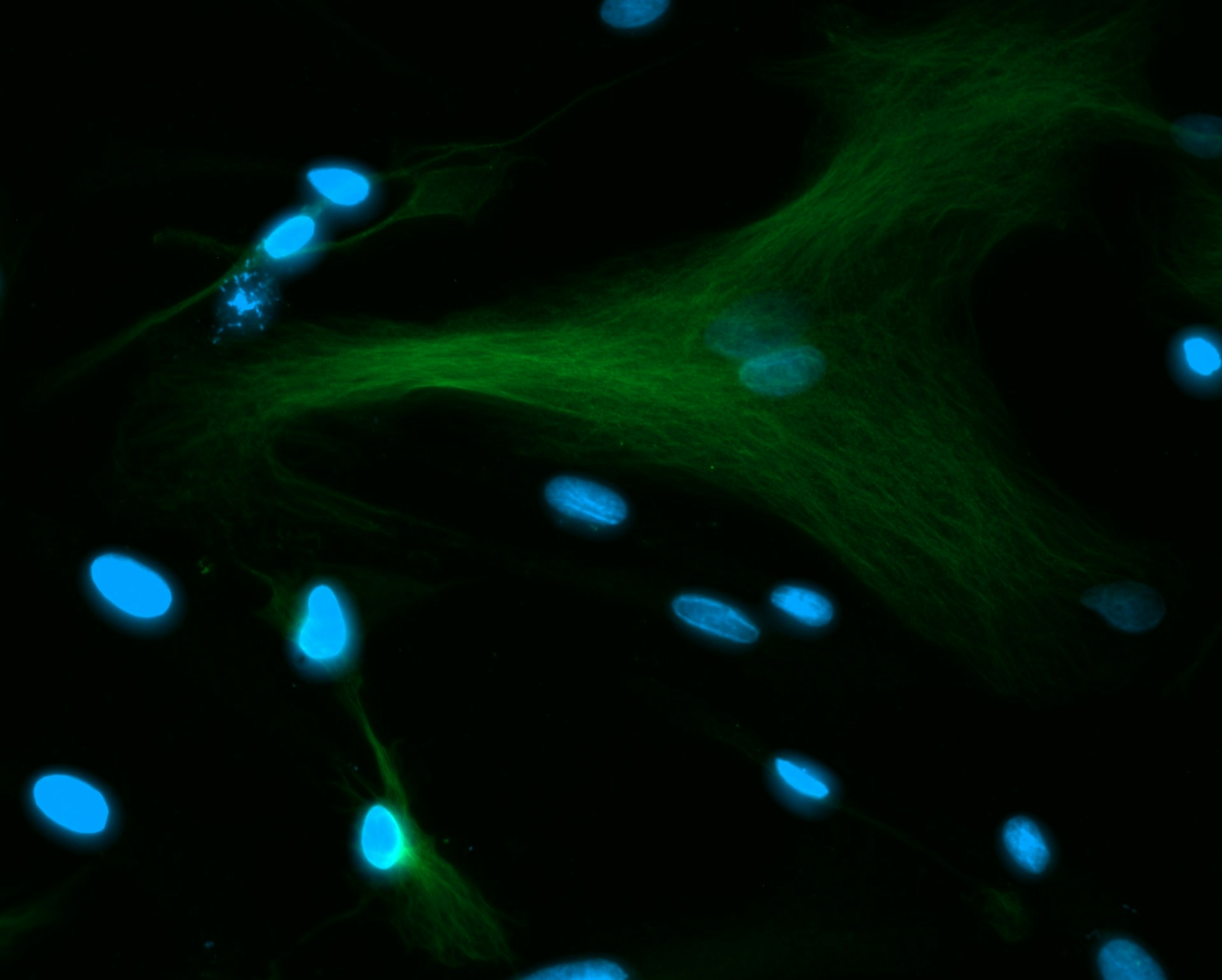
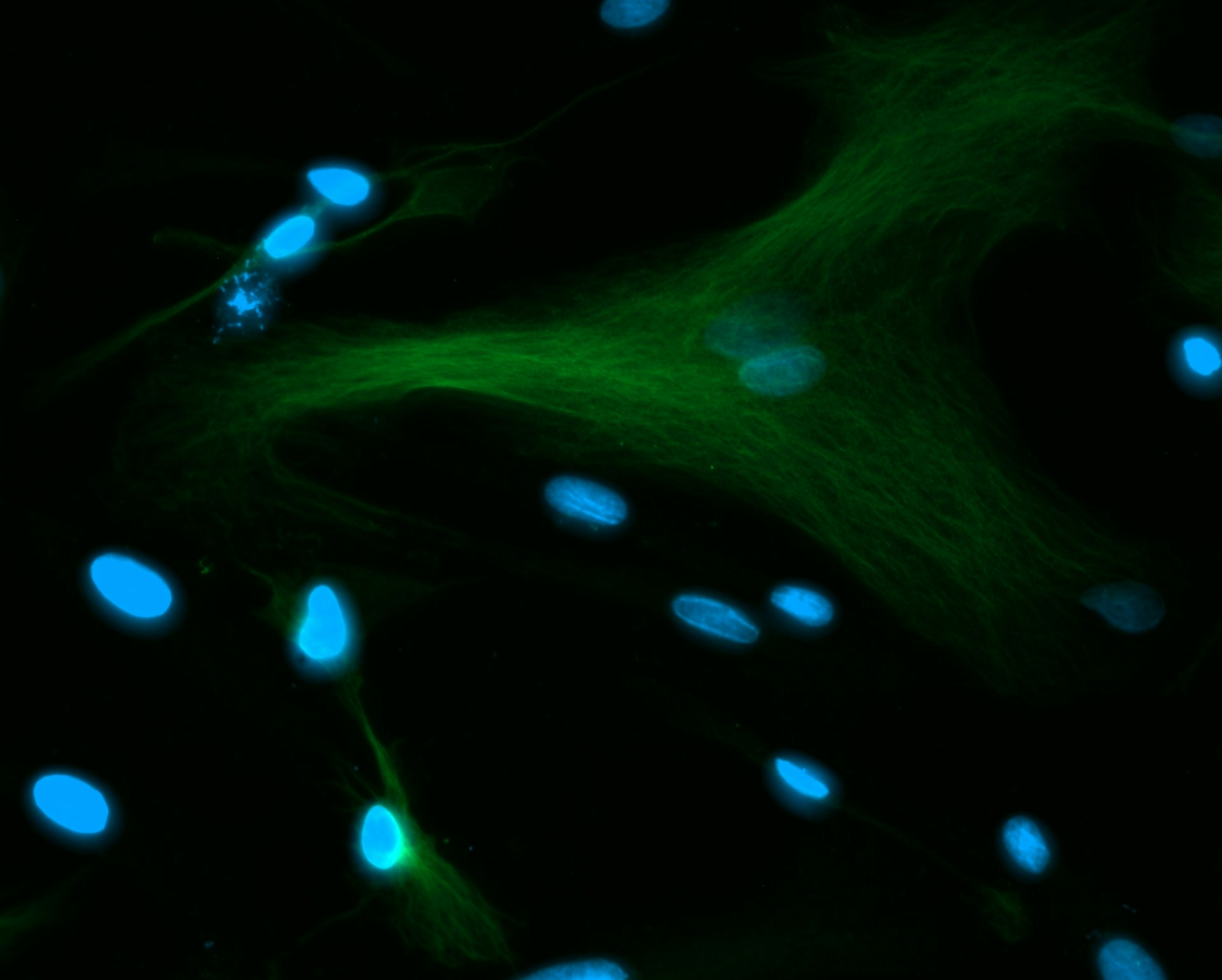
Fluorescence micrograph of cultured cells: green filament networks threading between bright blue-stained nuclei
ANCHORAGE · FIELD 03 · CELL ON MESH
Site 01 · the repeat block

At the end of each chromosome arm, a few thousand base pairs of TTAGGG folded back on itself into a loop. Phase three writes back what the cycle's divisions spent and re-forms the loop. It matters because the repeat block is the one structure in a cell that keeps a running total of how much repair a lineage has already done. Energy can be topped up. Progenitors can be recruited. Matrix can be rebuilt. This is a ledger, and until phase three it only ever ran in one direction.

Site 02 · the inner membrane

The cristae of the mitochondria local to a tagged site. Biogenesis is raised for the length of the cycle and NAD+ is held above its working threshold, so the wound bed carries 2.4× its baseline respiratory capacity from T+9 onward. It matters because everything else on this page is a demand and this is the supply. Speed the demand without the supply and the cell meets the shortfall by consuming itself, which is a fast wound and a poor one.

Site 03 · the reserve

The perivascular niche each tissue keeps its own progenitors in. Tagged sites call them directly: a niche that would ordinarily release its first cohort over four to six days empties it in under three hours. It matters because the reserve is finite and shrinking, and the body's usual way of drawing on it is a shout rather than a request — an inflammatory gradient recruits several times the cells a wound needs and spends the difference. Addressed recruitment spends what the wound costs.

Site 04 · the mesh outside

The collagen lattice the cell anchors to, and the only address on the far side of the membrane. Through the whole III-to-I substitution the new fibre is held to the axis the tissue was loaded on before it was cut. It matters because scar and tissue are the same protein at the same volume; the difference between them is direction. A mesh laid on the load axis carries what the original carried, which is the only definition of healed the limb itself recognises.

The lock, and what holds it

Holding a repeat-extension window open in an adult somatic cell is the part of this that had to be built rather than found, and it is held by three independent gates. The window opens only inside a tagged cell. It is bounded at seventy-two hours by the phase clock. It closes on the carrier's own decay, clock or no clock. Any one of the three ends it, and across the phase-characterisation series no tagged lineage has held a window past T+74.

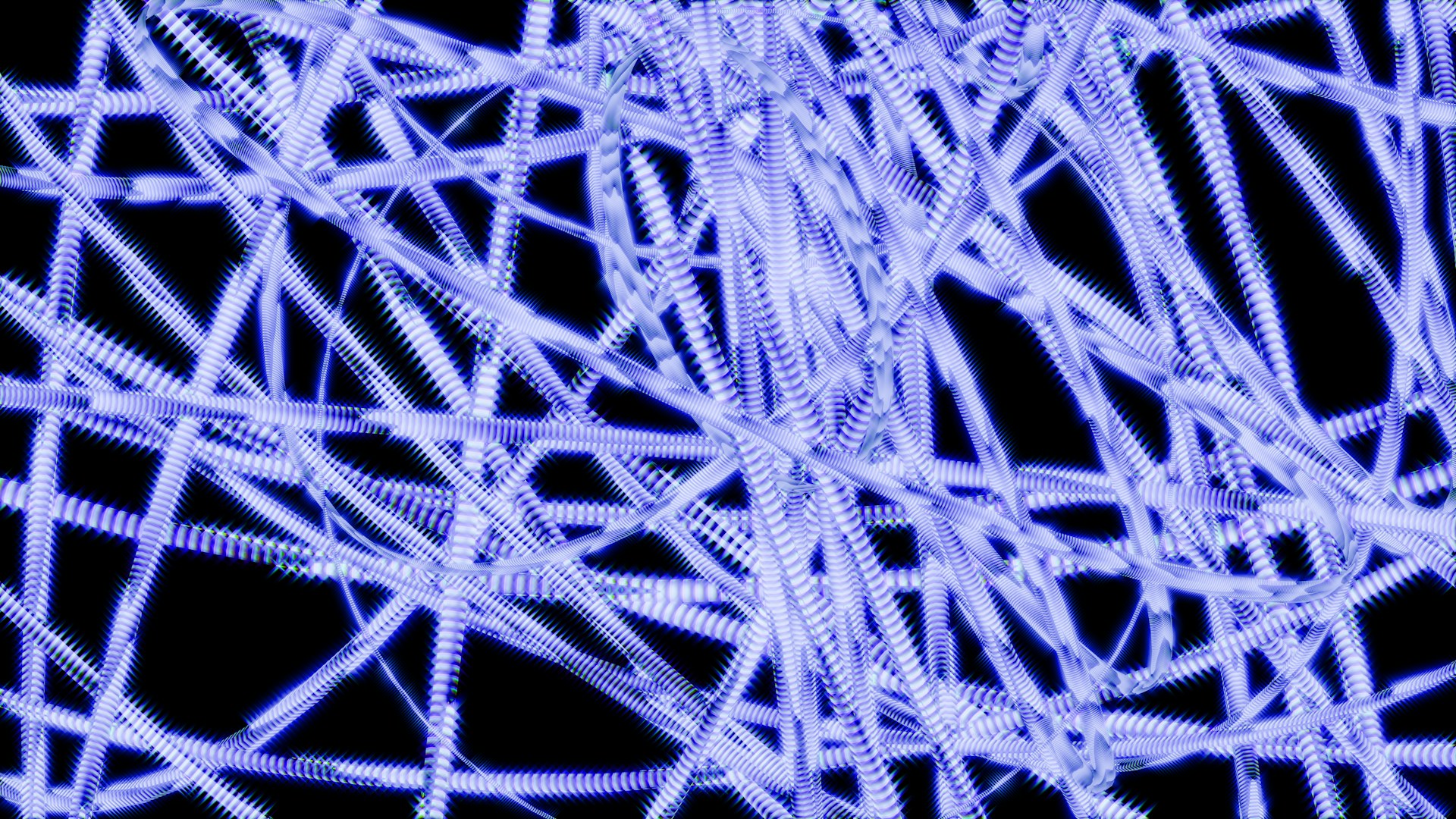
A dense tangle of pale coiled filaments crossing one another at every angle, with no common direction, against black

Cut tissue lays its fibres wherever the wound edge points. The load runs one way, the mesh runs every way, and the join gives at the first hard pull.

MATRIX ALIGNMENT · SCAR VS. REMODELLED

Working vocabulary, 1 of 2 — the division ledger and its energy supply
TermWhat it isWhat ORVENNE-1 does there
TelomereTTAGGG Repeat sequence capping each chromosome arm; shortens with every division. Rewrites the repeats spent during a repair cycle.
Telomerase The enzyme that extends those repeats; largely switched off in adult somatic cells. Re-opens the window transiently, and only in tagged cells. Bounding that window is the programme's central safety constraint.
Hayflick limit The division ceiling a somatic lineage reaches as its telomeres run out. Treated as a budget rather than as a wall.
Mitochondrial biogenesis Formation of new mitochondria; the supply side of cellular energy. The cell builds more of them, locally, so the repair is paid for out of new supply.
ATP synthase The rotary enzyme that makes the cell's energy currency. The meter the two rows above are read on: output per cell, per hour, at the wound bed.
Computer-rendered lattice of dark spheres joined by thin struts, with scattered nodes glowing cyan through the structure

VOCABULARY 1 OF 2 — ENDS: INSIDE THE CELL VOCABULARY 2 OF 2 — BEGINS: THE MESH OUTSIDE IT FIELD 04 · CYTOSKELETON AT 40 H

Working vocabulary, 2 of 2 — the repair site
TermWhat it isWhat ORVENNE-1 does there
Extracellular matrixECM The structural mesh cells live in, anchor to and build on. The tissue keeps its own pre-injury axis; ORVENNE-1 only holds it there.
Collagen I & III remodelling Substitution of provisional collagen III for load-bearing collagen I. Held to the original fibre orientation for the whole substitution.
Senescence-associated secretory phenotype The inflammatory signal set maintained by cells that have stopped dividing. Suppressed at the tagged site. Unchanged everywhere else.
Autophagy Managed self-digestion; how a cell clears its own damaged parts. Runs first and keeps running. Every rebuild starts on cleared ground.
NAD+ A coenzyme gating a large amount of repair and metabolic signalling. Held above the working threshold for the length of the cycle.
Lipid nanoparticle delivery A fatty shell used to carry a payload through circulation. 84 nm here; it is what sets the immune-quiet window.
Tissue-resident progenitor cells The local reserve a tissue draws on when it rebuilds itself. They come to the tag instead of waiting for an inflammatory signal to call them.

Terms are used in their standard sense. Where the right-hand column says held or suppressed, it means at the tagged site, for the length of one cycle, and there only — the scope of every entry in this table is the tag.

T+0 to year twenty

Three timescales, kept separate

Three effects on three clocks. The first closes a wound in days. The second lowers a maintenance load over weeks, and is the one long-term users notice first. The third changes a rate that is otherwise fixed for life. They are measured apart and they are written apart, because the first two are the reason people start and the third is the reason the company exists.

Hours → days 0–72 h
acute repair

A cut, from the inside

Take one clean surgical incision. Twelve centimetres, closed and dressed at eleven in the morning.

Untreated, what follows is a relay with very long handoffs. A clot by noon. Inflammation through the night, which is the body shouting for cells it has no address for. Provisional matrix on the second day. On the third, a fibroblast front leaves the wound margins and starts inward at six-tenths of a millimetre a day — less than a millimetre, into twelve centimetres. Then remodelling, which runs eighteen months and stops rather than finishes.

Under ORVENNE-1 it is the same relay. The handoffs are what change.

By T+40 min the line is tagged end to end. By T+3h the first progenitor cohort is in the bed — not crawling in from the edges but arriving at the tags, which are everywhere the cut is. The inflammatory summons is skipped and the two days it costs go with it. Collagen III is going down by T+7. The substitution to collagen I starts at hour thirty-two, an event that in the untreated wound belongs to the eleventh week.

Closure at seventy-two hours: 99.1 per cent, against 63.7 in matched controls. Thirty-five points, in three days.

Then the part people actually notice, which arrives much later. At week twelve the scar has stopped behaving like one. It is thin, it takes a stretch, and under polarised light the fibre inside it runs the same way as the fibre either side of it. Whether a wound becomes tissue or becomes scar is decided in the first thirty-two hours, by one thing: the direction the first collagen was laid in.

exposed collagen I ends fibroblast migration collagen III → I local autophagy
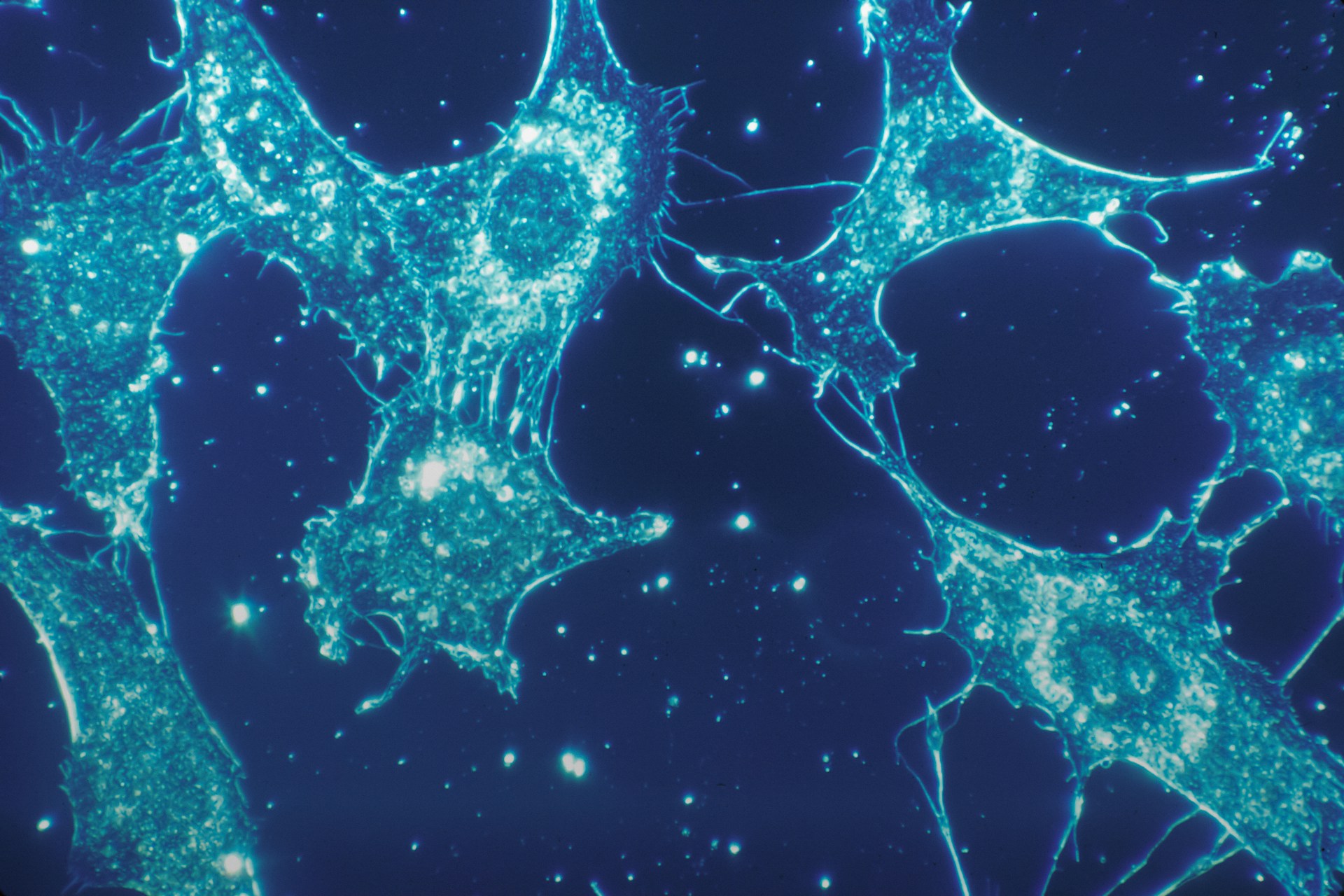
Fluorescence micrograph: cyan-stained cultured cells spread flat across a deep blue field, their edges drawn out into fine branching processes
MIGRATION FRONT · FIELD 01 · T+18 H
100% 50% 0% 0h 36h 72h Δ 35.4 pts ORVENNE-1 matched control
Closure, 0–72 h — per cent of wound area closed Δ 35.4 pts at 72 h
Weeks → months 4–40 weeks
maintenance

Maintenance, which is mostly cleaning

The second effect has nothing to do with wounds, and it is the one long-term users describe first.

Tissue takes damage continuously and clears it continuously: microtears, cross-linked collagen, aggregated protein, and cells that have stopped dividing while carrying on signalling. Both rates fall with age. Clearance falls faster. Somewhere in the fourth decade the two curves cross, and from that morning onward every tissue in the body carries a balance it will spend the rest of its life adding to.

ORVENNE-1 raises clearance. Autophagic turnover at the tagged sites runs at 2.1× the age-matched rate; the secretory phenotype senescent cells maintain is held down at those sites for the length of the cycle; and the respiratory capacity from site two pays for both at once, so the two are bought together rather than traded off. The ledger balances.

Measured, that is a 41 per cent fall in circulating inflammatory load by week sixteen, and a cross-link density at week forty that matches the reading the same person gave at intake.

Described, it is duller and far more convincing. People say they recover faster. They say the second day after a hard week now feels the way the first day used to. Asked outright whether they feel younger, most of them shrug — and then describe a calendar they have spent six months emptying.

Fluorescence micrograph, narrow field: green cytoskeletal filaments crossing between scattered blue-stained nuclei on black
TURNOVER · FIELD 02 · WK 24
SASP suppression autophagic turnover NAD+ availability mitochondrial biogenesis cross-link clearance
Years 52 weeks +
rate intervention

Slowing the meter

The third effect is the one the programme was built for.

Every division spends telomere. Repair means division. A compound that speeds repair and stops there therefore spends the reserve faster than the body would have, brings the division ceiling forward, and buys a spectacular decade at the price of everything after it. Two generations of this class of work walked into exactly that, and it is the reason phase three exists.

Repeats spent during a cycle are written back at the end of it. A hundred and twenty-eight base pairs against a spend of between seventy-four and a hundred and forty-eight. The cap re-closes. The reserve finishes the cycle at the level it started, and across the ORVENNE-3A cohort at fifty-two weeks the median reserve stands 1.4 per cent above intake.

Hold that across enough cycles and the arithmetic changes character. A reserve that falls is a lifespan. A reserve that holds is a rate — and a rate is a setting.

That is the line on the front of the bottle, and it is why the Ellenby arm runs twelve years rather than one. Fifty-two weeks establishes that a cycle closes level. Twelve years establishes what a thousand of them do. The cohort is in its fifth year. The line through the first four is flat to within the width of the assay.

Computer-rendered DNA double helices in pale blue and white, crossing a dark field and falling away out of focus
REPEAT BLOCK · WRITE-BACK
telomere write-back cap re-closure Hayflick budget progenitor reserve

The three tiers answer to separate endpoints on separate clocks, so they are reported separately. Between-subject spread is widest in the first tier and narrowest in the third — the reverse of what the programme expected in 2019, and the same way round at every readout since.

A lightbox holding a grid of cross-sectional head scans, seen out of focus

ORVENNE-3A · 52-week analysis

Thirty-five points,
at seventy-two hours

ORVENNE-3A was powered for one thing: closure at seventy-two hours against a matched control, in 4,820 people across twenty-six rooms and seven protocols. It returned 35.4 points, with the interval sitting entirely above thirty-three. Everything else on this screen was measured alongside that endpoint and is reported alongside it.

Repair capacity, 20 years from baseline
index, baseline = 100 · modelled
100 75 50 25 0 yr 0 yr 10 yr 20 held — index 92 natural — index 22 difference ELLENBY ARM · YEAR FIVE · LINE FLAT TO ASSAY WIDTH
Under ORVENNE-1 Natural decline Difference

Reading it. At year ten the two lines are fifty-one index points apart, which on this scale is the distance between a forty-year-old's repair capacity and a seventy-year-old's. Both start at the same index and part company inside the first year: the grey line is the decline this cohort's own intake readings predict for it, the green line is the same cohort held. Past week 52 the green line is carried forward on the fifty-two-week gradient, and the twelve-year arm at Ellenby is what turns that gradient into a series.

A large institutional building at dusk seen from a street corner, out of focus
SITE 04 · VALMARENA · EXTERIOR

Study record ORVENNE-3A

Record
ORVENNE-3A
Enrolled
4,820
Observation
52 weeks
Design
Randomised, double-blind
Sites
26, across 7 partners
Primary endpoint
Closure at 72 h
Primary result
Δ 35.4 pts, level at 72 h
Interval
33.1 – 37.6 pts
Withdrawn
61 · 1.3%
Status
52-week analysis reported

Controls were matched on age, wound geometry, perfusion index and time from injury to first dressing, in that order of weight, and drawn from the same twenty-six rooms on the same weeks. Twenty-six rooms, seven protocols, one compound. Every secondary reading is carried in the deck with its interval attached, including the four that went the wrong way.

×0.0

Closure velocity against matched controls

2.83 vs 0.75 pts/h, mean 0–24 h · controls = ×1.0

0.0yr

Median shift, biological age index

52-week median · secondary

+0.0%

Median telomere reserve against intake

wk 52 · n = 4,820 · same person, same assay

A bare concrete institutional interior: an open stair rising on the left, a long corridor lit by ceiling fittings, glass doors at the far end

72 h → 12 yr · seven sites

Seven rooms, seven
different questions

Seven institutions on four continents, each running its own protocol against its own question. A recovery centre wants a return-to-load interval in days; a cohort group wants a curve twelve years long; a foundation in Germany wants to know what the fibre is doing at the micron. Nobody here has been asked to confirm anybody else.

1 d 1 wk 1 mo 1 yr 10 yr 01 NORDWALL 02 CAPE HALE 03 ELLENBY 04 VALMARENA 05 FENNICK POINT 06 HALVERD 07 THIRLWAITE 6 wk 5 d 12 yr 52 wk 26 wk 12 wk 72 h SEVEN SITES · 1,460× BETWEEN THE SHORTEST AND THE LONGEST
Observation horizon by site · log scale 72 h → 12 yr
A dark gym: a lifter bent over a loaded barbell, lit from above so that only the shoulders, arms and shoes catch the light
SITE 02 · RETURN-TO-LOAD · CAPE HALE
Register of the seven partner institutions
Institution Kind What they run Since
01 Nordwall Institute for Regenerative PhysiologyVessholm · Norway National research institute Holds the phase-two scaffold work outright. Runs the fibre-alignment assays at a bench scale we have never had the room for, and has published the orientation series under its own name since 2023. 2022
02 Cape Hale Centre for Sport and Recovery MedicineCape Hale · New Zealand Clinical recovery centre Return-to-load protocols after ligament reconstruction, scored on the pitch rather than in the scanner. The only partner on the register that measures a person instead of a sample. 2023
03 Ellenby Longitudinal Cohort in Human AgeingEllenby · United States Twelve-year cohort study Owns the twelve-year arm and the decline baselines every chart on this page is drawn against. Now in its fifth year, and the only room here that can answer what a thousand cycles do. 2021
04 Istituto Valmarena per la Medicina dell'InvecchiamentoValmarena · Italy Clinical ageing medicine Frailty indices and recovery-interval endpoints across fifty-two weeks, scored against the cohort's own intake baselines rather than ours. Holds the second scoring of the ORVENNE-3A tables. 2024
05 Fennick Point Station for Extreme Environment MedicineFennick Point · Antarctica Polar and hypobaric station Pre-exposure conditioning at altitude and in cold, six months at a time, with rotations that come back through their own clinic. Their numbers are the worst of the seven and have been since the first week. 2024
06 The Halverd Foundation for Tissue ArchitectureHalverd · Germany Endowed research foundation Builds the matrix analogues that test whether remodelling follows the load axis or the wound geometry, at a micron of resolution. Twelve-week horizon, and the hardest single question on the register. 2023
07 Thirlwaite Laboratory for Cellular EnergeticsThirlwaite · Scotland Independent bioenergetics laboratory Respirometry and NAD+ flux. Derives the energy budget for a repair cycle from first principles, blind to our figure. Their first number came in eleven per cent under ours. We moved; they have not had to. 2025

Seven partners, seven protocols, one compound. Where a partner's figure disagrees with ours, both go into the deck. Fennick Point's have disagreed from the first week, and they stay in.

A figure seen from behind, sitting in a large empty window frame, looking out at a flat grey sea

Around the ninth week people stop describing what changed, and start describing what they have stopped planning around.

Post-surgical High training load Altitude and cold Long horizon

What people say

Nobody talks
about telomeres

Four accounts, one from each setting, taken at four different points on four different clocks. Asked what changed, people describe a calendar rather than a body.

At the three-week check the surgeon pressed along the line and asked me twice whether I'd actually had the operation. Not as a joke — he went back through the notes. I had four months blocked out in the calendar for this. I have spent the last six weeks deleting things from it, one afternoon at a time.

Portrait: a young man in glasses and a black turtleneck, seated against a grey backdrop
Håkon Vestli Post-surgical · elective repair
Wk 9

Same weekly load, week on week. Tuesday numbers where Thursday's used to be. Two sessions back in. That is the whole report.

Portrait: a woman with her hair tied back and dark red lipstick, lit against a black background
June Ferraday High training load · endurance block
Wk 24

Three days to come back from a rotation. Eleven years of that. Now it is one. I work the Thursday I used to lose.

Portrait: an older man with white hair and a beard, arms folded, against a dark teal background
Bo Løvgren Altitude and cold · field rotations
Wk 40

The report does not say I got younger. It says that for one year my line was flat. I keep the page in the drawer with my passport.

Portrait: a woman with long grey hair and black-framed glasses, lit against a black background
Alma Reisz Long horizon · cohort arm
Wk 52
Archive photograph of two masked, hooded technicians working either side of a large distillation flask
An automated laboratory instrument seen through glass under blue light: a robotic head poised above a row of sample trays

Eleven weeks, and the fault was a thermostat three floors below us.

FORMULATION BAY · CARRIER LINE

From the chief scientist

The version we nearly shipped worked beautifully, except on Mondays.

ORVENNE-0.9 was finished. We had the closure data, we had the write-back, the deck was written. And then for eleven weeks the carrier failed in a pattern I could not make sense of: fine Tuesday through Sunday, poor on Monday, worse on the Mondays after a public holiday. I blamed the incubator. I replaced the incubator. It failed on the next Monday.

It was the building. The campus chilled-water loop steps down two degrees at four in the morning when the plant cycles back up for the week, and the phospholipid shell sets differently at that temperature. Not badly. Just differently enough that the immune-quiet window closed at fifty hours instead of seventy-two. Eleven weeks, one thermostat three floors below us, and nobody in the group had any reason to know it existed.

I kept a folding chair in the cold room for most of that spring, which my team found funny and which I would do again. After that we stopped calling it a formulation problem and started calling it a weather problem. The version we did ship is specified across a four-degree band rather than at a temperature. That is the whole change. It is also the only part of the last decade I would put on a wall.

Marit Sundqvist — Chief Scientist, ORVENNE programme

Fluorescence micrograph of cultured cells: green filament networks threading between bright blue-stained nuclei
FIELD 04 · carrier uptake at T+40 h

ORVENNE programme · core group

Marit Sundqvist

Chief Scientist, ORVENNE programme

XR-01

Tobias Rennick

Telomere group

PHASE III

Aiko Vandeveer

Bioenergetics and respirometry

NAD+ / ETC

Priya Ashworth-Bell

Delivery systems

LNP

Nils Oyelaran

Study design and statistics

BIOSTAT

Five people hold the work described here. The account above belongs to the first of them.

Long-exposure light trails forming smooth green and blue waves across a black field

ORVENNE programme · enquiries

The long version is written to be checked

What is here is the short account. The deck carries the full phase characterisation, the ORVENNE-3A endpoint tables with every secondary reading left in, the carrier specification across its four-degree band, and all seven partner protocols on their own horizons — including the four readings that went the wrong way, and Fennick Point's, which have disagreed with ours since the first week.

4,820 enrolled 26 rooms 7 protocols